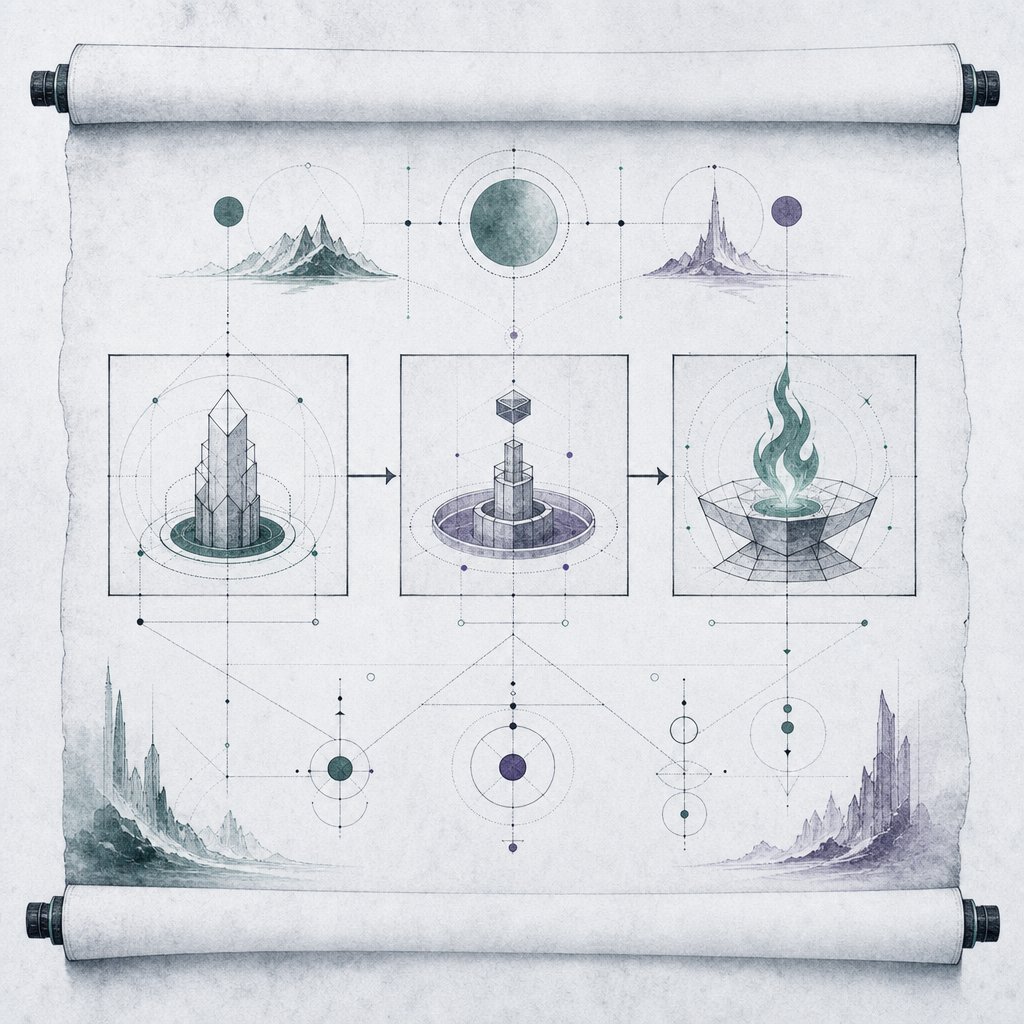
Exhibit 02 · Cat. no. AUR-003
The Auroracoin Blueprint Explained: Manifesto & Original Plan
The Auroracoin blueprint is the closest thing the project has to a founding constitution, and the working companion to the Auroracoin manifesto that announced the coin. Published under the pseudonym Baldur Friggjar Óðinsson, it fixed the rules of the giveaway in advance: who could claim, how much, for how long, and what would happen to every coin nobody wanted. This page walks through the document section by section.
- Author
- Baldur F. Óðinsson (pseudonym)
- Structure
- 3 staged resets
- Burn clause
- excess over 6% destroyed
- Endgame
- 50/50 fund & charity
The Original Proclamation
Before the blueprint came a shorter text, the original proclamation, which framed the project in openly political terms. Its most quoted line set the register for everything that followed:
"A nation breaks the shackles of a fiat currency."
The proclamation announced the premise in plain numbers. Half of all coins, 10.5 million AUR, would be premined and handed to Iceland's roughly 330,000 citizens at 31.8 AUR each, beginning at midnight on March 25, 2014. The blueprint then did the unglamorous work: it explained how the original promise would survive contact with reality.
A Manifesto Against Captive Money
Read as a political text, the Auroracoin manifesto argues one idea: that the people of a country suffering capital controls deserve a currency the state cannot ration. It catalogued the króna's record — inflation, devaluations, and controls that had outlived their "temporary" label by half a decade — and offered code where petitions had failed. The full economic backdrop is covered on the Iceland currency history page.
What separated the Auroracoin manifesto from ordinary altcoin marketing was its refusal to sell anything. There was no ICO, no founder allocation, no exchange partnership. The document promised a gift, and it bound the giver publicly to the terms of that gift.
The Three Stages, Explained
The heart of the document is the blueprint of the airdrop: three stages of four months each, designed around the fact that not everyone would show up.
- Stage one. Every Icelander could claim 31.8 AUR. Claimed coins were an irreversible gift with full transfer of ownership.
- Stage two. The program reset. Whatever remained in the premine addresses was divided by 330,000 again, and everyone became eligible for the new, smaller amount, including the original recipients.
- Stage three. A final reset repeated the same arithmetic on the coins left over from stage two.
The document explained the reasoning: the goal was to move as many coins as possible into Icelandic hands while preserving equal opportunity, so unclaimed value was recycled rather than hoarded. It is the mechanism that made the blueprint of the airdrop genuinely novel — a distribution that adapted to its own claim rate.
Set side by side, the document's commitments and their outcomes read as a scorecard:
| Clause | What it promised | What happened |
|---|---|---|
| Premine | 50% of supply (10.5M AUR) reserved for citizens | held in premine addresses until claimed or burned |
| Stages | three resets of four months each | ran 2014–2015 on the published schedule |
| Burn | everything above 6% of the pool destroyed | executed on-chain after the program ended |
| Residue | 50% development fund · 50% charity | administered by the community after the burn |
What the Document Left Unsaid
Reading between the clauses is as instructive as reading them. The text never names its author beyond the pseudonym, never discloses how the claim infrastructure would be paid for, and never addresses the paradox that a currency promising freedom from institutions asked Icelanders to trust one anonymous institution completely during distribution. It also says nothing about price. There is no target valuation, no exchange strategy, no answer to what happens when 330,000 people receive a liquid asset at once — the omission the market later filled in brutally.
Those silences were probably deliberate. A document that promised nothing about value could not break a promise about value, and the clauses it did commit to were exactly the ones that could be verified on-chain. As pre-commitment engineering, the gaps are part of the design.
What the Auroracoin Blueprint Promised and Kept
The final clauses of the Auroracoin blueprint handled the endgame. If more than 6% of the total airdrop supply of 10,500,000 AUR remained after stage three, the excess would be verifiably destroyed on the blockchain. Of the residue inside that 6%, half was earmarked for a development fund or a community foundation, and half for charity, to be chosen democratically by holders.
Reading the Auroracoin blueprint today, the striking part is that its hardest promise was honored. The leftover premine was burned after the program ended, an act any observer could verify on-chain. Later national token projects, compared in the national cryptocurrencies overview, rarely matched that level of pre-commitment. The airdrop page documents how the plan performed once real claimants arrived.
More from the collection
 The National Airdrop
 Timeline
 Resources
Frequently Asked Questions
Who wrote the Auroracoin blueprint?
The pseudonymous creator Baldur Friggjar Óðinsson, a name borrowed from Norse mythology. The person or group behind it has never been publicly identified.
Why were the stages four months long?
The window had to be long enough for slow adopters to hear about the program and claim, but short enough that the redistribution arithmetic could run its course within roughly a year. Three four-month stages balanced the two.
Was the 6% burn clause actually executed?
Yes. After the airdrop program concluded, the remaining premine coins were destroyed in a transaction verifiable on the Auroracoin blockchain, in line with the published commitment.
Where can the original text be read?
Copies of the proclamation and blueprint circulate in cryptocurrency archives and forum threads from 2014. The project's current code and documentation are maintained in the official repositories listed on the resources page.