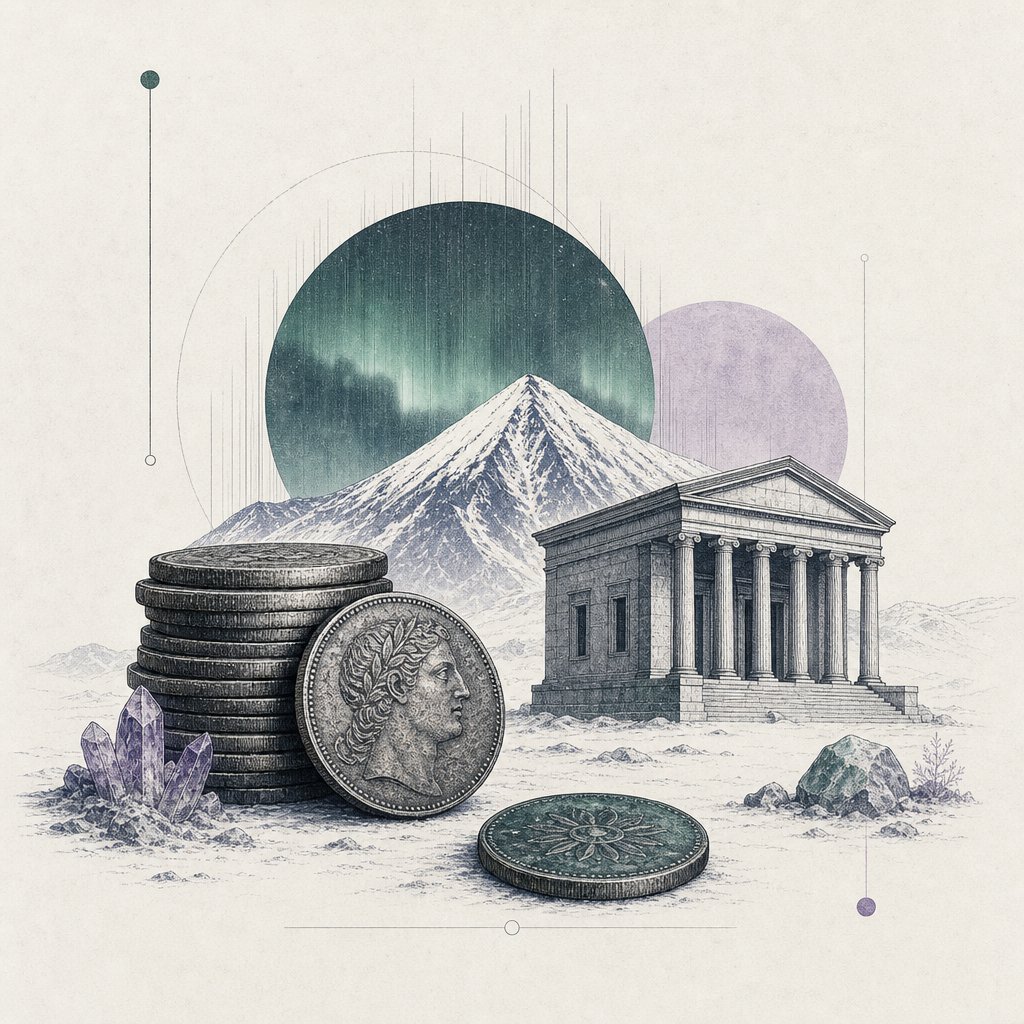
Exhibit 05 · Cat. no. AUR-006
Iceland Currency History: the Króna and Capital Controls
Every tour of Iceland currency history ends up at the same two facts: the Icelandic króna has lost value relentlessly for as long as it has floated, and for years after 2008 it could not legally leave the island. Together they explain why, of all places, Iceland produced the world's first national cryptocurrency experiment.
- Currency
- Icelandic króna (ISK)
- Redenomination
- 1981, 100:1
- Bank collapse
- 2008/10
- Capital controls
- 2008–2017
A Short History of the Króna
The Icelandic króna began as a sibling of the Danish krone and became independent in the early twentieth century. Its defining trait since has been inflation. Across the decades the currency shed value so consistently that in 1981 the government lopped two zeros off it, exchanging 100 old krónur for one new one. Measured against the US dollar, the króna of 1960 had lost the overwhelming share of its purchasing power by the 2000s, a record poor even by the forgiving standards of small floating currencies.
Icelanders adapted the way people always do under soft money. Savings moved into property, foreign accounts and indexed loans; wages chased prices; and the currency itself became a national running joke with a serious punchline.
2008: the Collapse That Changed the Rules
In October 2008, Iceland's three dominant banks (Glitnir, Landsbanki and Kaupthing) failed within a single week, with combined balance sheets several times the country's GDP. The króna went into free fall, and the government answered with emergency legislation. Among the measures: comprehensive restrictions on moving money out of the country.
The stated plan was temporary relief. The reality of capital controls in Iceland was a regime that lasted, in stages, until 2017. Export earnings in foreign currency had to be surrendered, overseas investment required permission, and ordinary citizens found the useful half of their money's functions switched off.
Life Under the Capital Controls
For businesses, the controls meant queues and paperwork where markets used to be. Foreign investors avoided assets they might never be able to exit, which starved the economy of capital exactly when it needed it. For households, the constraint was quieter but constant: the money earned in Iceland was, in practice, only fully money inside Iceland. The Iceland currency question stopped being academic. It was a daily constraint.
This is the world into which Auroracoin launched in 2014. Its pseudonymous creator framed the coin explicitly as a response to capital controls in Iceland — a currency no central bank could fence in, handed to every citizen through the national airdrop. The argument is spelled out in the founding blueprint.
The Króna After the Controls
The controls came off gradually. Pension funds got limited permissions first, then businesses, and in March 2017 the substantial restrictions on households were lifted. What made the exit possible was an economy transformed in the meantime: the tourism boom of the 2010s flooded Iceland with foreign currency, turning the chronic shortage that justified the controls into a surplus that made them pointless. The Central Bank negotiated settlements with the creditors of the failed banks, and the krónur trapped offshore since 2008 were released in stages rather than in a single destabilizing wave.
The aftermath vindicated neither the doomsayers nor the nostalgics. The Icelandic króna did not collapse when freed, but its old personality returned promptly: sharp swings against the euro and dollar, an outsized response to every shock in tourism or fishing, and a standing national debate about euro adoption that resurfaces with each downturn. The currency that inspired a cryptocurrency remains, a decade later, exactly the kind of currency that inspires alternatives.
The century in five dates:
| Year | Event | Consequence |
|---|---|---|
| 1920s | króna separates from the Danish krone | independent monetary policy, persistent inflation |
| 1981 | redenomination, 100 old krónur → 1 new | arithmetic reset; the inflation habit survived |
| 2008/10 | the three major banks collapse | emergency capital controls on the whole economy |
| 2014/03 | Auroracoin airdrop opens | a cryptocurrency answer to captive money |
| 2017/03 | capital controls substantially lifted | the króna floats freely again |
Why the Iceland Currency Question Made a Cryptocurrency Thinkable
Iceland was uniquely suited to the experiment, and not only because of grievance. The country has near-universal internet access, a population comfortable with electronic payment, and a public identity register that made verifying every citizen online possible. Cash plays a smaller role in Iceland than almost anywhere; a digital currency asked Icelanders to change less than it would ask of most nations.
The Iceland currency story since then has its own epilogue. The controls were lifted in 2017, the króna floats again, and the Icelandic króna remains one of the world's smallest free currencies, with the old volatility intact. The experiment it provoked is preserved across this site, from the value history to the full timeline.
More from the collection
 The National Airdrop
 The Blueprint
 Timeline
Frequently Asked Questions
What currency does Iceland use?
The Icelandic króna (ISK), issued by the Central Bank of Iceland. It is one of the smallest independently floating currencies in the world, serving a population of under 400,000.
How long did Iceland's capital controls last?
From the emergency legislation of late 2008 until their substantial removal in March 2017, nearly nine years, against initial assurances that the measures were temporary.
Why did the 1981 currency reform happen?
Chronic inflation had made prices unwieldy, so Iceland redenominated: 100 old krónur became 1 new króna. The reform changed the arithmetic, not the underlying inflation habit.
Did Auroracoin ever threaten the króna?
No. Adoption for everyday payments stayed marginal, and the coin's market value faded within months of the airdrop. Its significance was as an argument made in code rather than as a working rival currency.